Alice Gould’s undercover admission to the sanatorium
Los renglones torcidos de DiosAlice Gould’s undercover admission to Nuestra Señora de la Fuentecilla Psychiatric Hospital begins as a calculated professional deception and becomes the mechanism by which she can be detained. She enters to investigate a crime for her client, Raimundo García del Olmo, relying on Samuel Alvar’s advice to feign paranoia. Yet the paperwork later reveals that the hospital has processed her as an involuntary patient at her husband’s request. The investigation therefore turns on a bitter contradiction: Alice believes she has entered the institution by choice, while its official records give others power over whether she may leave.
Assignment and Preparation
Alice’s mission is to investigate a murder and identify its perpetrator, its instigator, or both. Raimundo García del Olmo, her client, has paid her an advance and promised an equal amount if she completes the work successfully. The fee initially seemed excessive; once she understood the conditions under which she would have to investigate, she recognized why it was so high. The assignment requires her to work among people whose suffering is mental rather than visible, in a setting she finds profoundly distressing because she cannot easily bear the sight of other people’s pain.
Samuel Alvar is her accomplice and the person who knows for certain that she is mentally healthy. He advised her to pretend to be paranoid, a choice suited to an undercover role because, as Alice reasons, a person with paranoia might remain intelligent and capable of carrying out professional duties while appearing abnormal chiefly through a particular delusion. Alvar is also an intimate friend of her client and is meant to provide information about suspects. His name repeatedly occupies Alice’s thoughts: the partnership that makes her investigation possible is also a point of fixation as she enters the hospital’s uncertain world.
Arrival and Admission
The opening image places a man and a woman in a car. As it slows, the man turns off the paved road, stops on a grassy clearing, and walks toward the edge of a rise; the woman follows. This restrained arrival precedes the more consequential threshold: Alice enters a place where her professional disguise will be read as evidence of illness. At the hospital, her composure and carefully prepared responses help sustain the role. The fact that staff do not believe she is a detective appears to serve her purpose, since questioning or taking notes can be attributed to her supposed delusions rather than to an investigation.
The intake process makes the role physical and administrative. When a staff member declares that Alice has been admitted and orders an object collected, she bends with a trembling hand to retrieve her white-gold lighter and hand it over. Her clothing, toiletries, handbag, and hand luggage are exhaustively inventoried and sealed. The seizure of personal effects is not incidental scenery: it marks the conversion of a visitor and investigator into a person subject to the institution’s procedures. The large women’s pavilion is divided by a corridor, with individual rooms on one side and a much larger collective dormitory on the other; Alice learns that the collective room is for the calmer residents, while other wards house people with more acute needs.
The Investigation Inside the Institution
The hospital’s open regime gives residents relative freedom to move through its buildings and grounds. They may spend time in the bar, play cards or dominoes, walk in the garden or surrounding wooded area, attend occupational therapy, or work in workshops that make goods for sale and pay patients according to their abilities and output. Some residents may even leave the grounds and take a bus to nearby towns. This apparent latitude gives Alice room to observe and ask questions, but it does not remove the distinction between freedom of movement inside the hospital and the right to depart from it.
Alice understands that she must search among the women’s accommodation and the men’s separate sleeping quarters for the person who committed the crime or arranged it. Her surroundings repeatedly expose the costs hidden beneath the language of treatment. The hospital includes units for people in crisis, and the most severely impaired residents in the dementia ward nicknamed the Lion Cage may depend on attendants to dress and feed them, put them to bed, and help them use the toilet. Against that institutional reality, Alice’s determination to investigate is shadowed by her awareness that the people around her are not merely clues in a case but vulnerable residents living under care and supervision.
The Legal Reversal
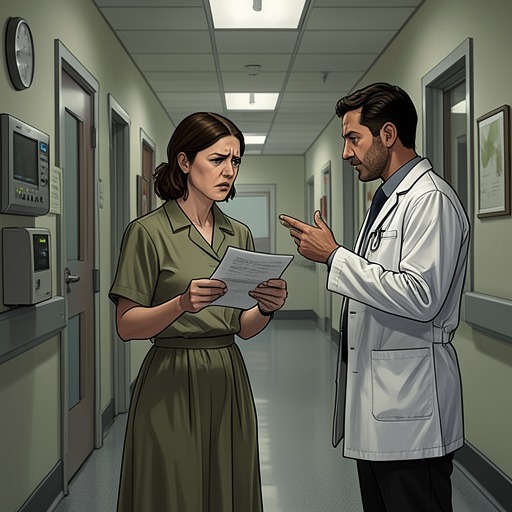
Alice’s understanding of her status collapses when the director explains that her file does not record a voluntary admission. A voluntary patient would have signed a declaration requesting treatment, accompanied by a certificate from the receiving doctor. Alice’s papers instead follow the procedure for involuntary commitment: a medical certificate from E. Donadío, registered in Madrid, attesting to illness and the need for confinement, together with an application from her husband, Heliodoro Almenara, as a relative. Alice protests that she came of her own will and is a professional detective, but the file gives her protest no power to change the basis on which she has been admitted.
She later grasps the practical consequence of the distinction. A voluntary patient can leave almost as simply as she entered; someone committed at a relative’s request on medical recommendation cannot depart at will. In a later clinical meeting, the director states that the hospital has received her as a paranoid woman accused of trying three times to poison her husband, and that it accepted her on the recommendation of a doctor and her husband’s application. The dispute is no longer only about whether Alice is pretending to be ill. It concerns how a diagnosis, a family request, and an official record can combine to determine a person’s liberty.
Significance
The admission establishes the novel’s central uncertainty through competing accounts of Alice rather than through a simple failure of disguise. She is conducting a real investigation, and Alvar knows she is healthy; at the same time, the hospital possesses documents that describe her as ill and justify keeping her there. Her detective work depends on being mistaken for a patient, but that misrecognition becomes dangerous once the institution treats the mistaken identity as fact.
The contrast between the open grounds and the involuntary paperwork gives the episode its lasting tension. Residents may walk, work, and sometimes travel beyond the hospital, yet Alice discovers that apparent openness does not guarantee an individual’s freedom to leave. Her covert entry thus reverses its own premise: the person who came in to investigate a confinement finds herself caught inside a legal and clinical process whose authority she cannot dismiss simply by stating who she is.